
Dental crowns are tooth-shaped caps that cover the entire visible portion of a tooth, providing strength and protection for severely damaged teeth. While fillings and inlays repair smaller areas of decay, crowns offer a more comprehensive solution for structural integrity. At Perfect Dental, we help patients in Taunton, Methuen, Manchester, Hyde Park, and Attleboro determine if a crown is the right choice for their specific dental needs.
Understanding Dental Crowns
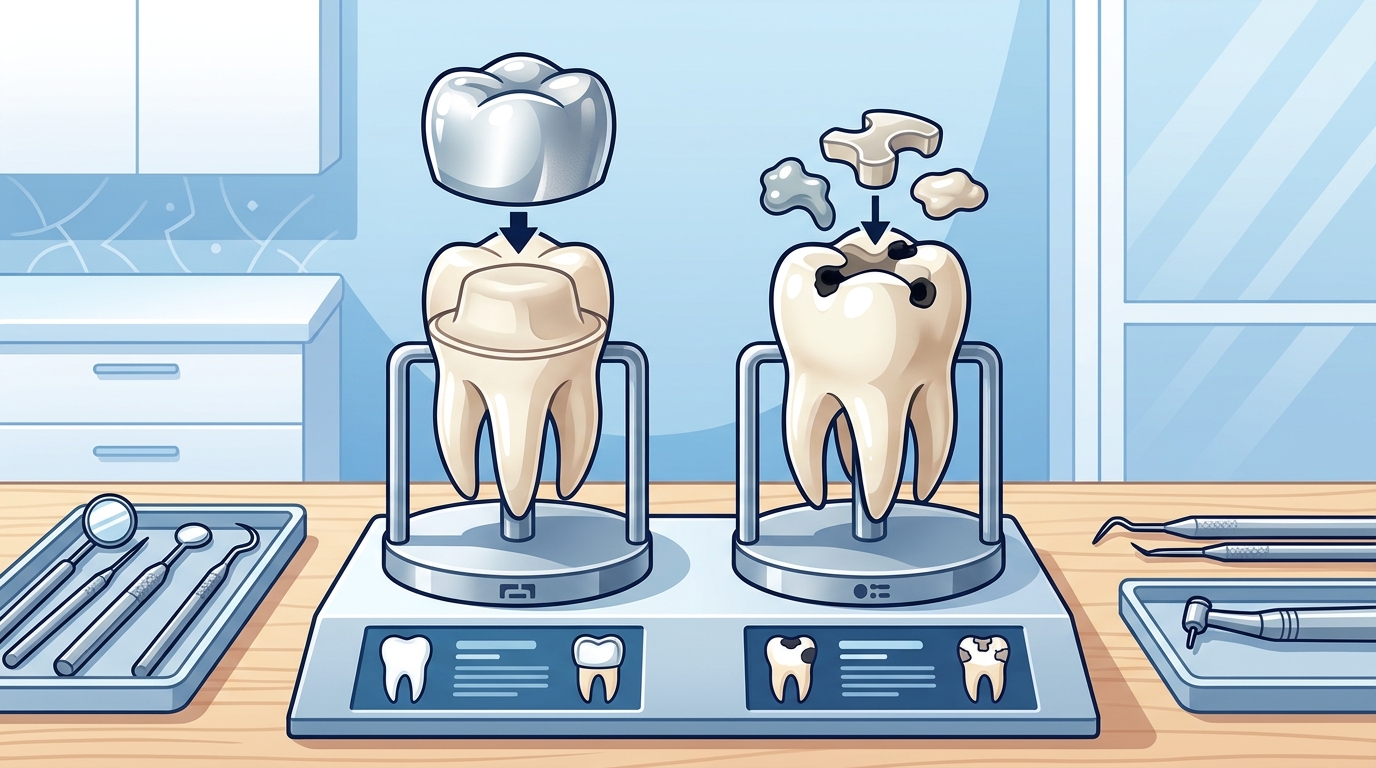
A dental crown is a custom-made restoration that encases the entire tooth structure. This full coverage is necessary when a tooth has suffered significant damage from decay, a large fracture, or a previous large filling. By covering the whole tooth, a crown prevents further breakage and restores the tooth's original shape and function. This makes them a critical component of restorative dentistry for long-term oral health.
When Are Crowns Recommended?
Crowns are typically recommended when a tooth has extensive decay that leaves too little natural tooth structure for a simple filling. They are also used to protect teeth that have undergone root canal treatment, as these teeth become brittle and prone to fracture. Additionally, crowns can be used to replace missing teeth as part of a dental bridge or to cap a dental implant.
Dental Crowns vs. Fillings
Dental fillings are the most common treatment for cavities. A filling is a material used to repair a tooth damaged by decay. Unlike a crown, a filling only replaces the decayed portion of the tooth, leaving the rest of the natural structure intact. This makes fillings a less invasive and often more cost-effective option for minor to moderate decay.
Strength and Coverage
The primary difference between a crown and a filling is the amount of tooth structure they cover. A filling is suitable when there is enough healthy tooth remaining to support the restoration. If the decay is too extensive, a filling may not provide sufficient strength, and the tooth could fracture under normal chewing forces. In such cases, a crown is required to distribute the biting forces evenly across the entire tooth.
Dental Crowns vs. Inlays and Onlays
Inlays and onlays are restorations that fit within or over the cusps (bumps) of a tooth. An inlay fits inside the tooth, while an onlay covers one or more cusps. These options are often referred to as "indirect fillings" because they are fabricated in a lab or digitally designed and then bonded to the tooth. They offer more coverage than a standard filling but less than a full crown.
Preserving Natural Tooth Structure
Inlays and onlays are ideal for teeth that have more decay than a filling can handle but still have enough structure to avoid a full crown. By preserving more of the natural tooth, these restorations can be a conservative alternative to crowns. However, they are not suitable for teeth that have undergone root canal therapy or have significant structural weakness.
Dental Crowns vs. Bridges and Implants
When a tooth is completely missing, a crown cannot be placed because there is no tooth structure to cover. In these cases, dental bridges or implants are used to replace the missing tooth. A dental bridge uses the adjacent teeth as anchors to support a false tooth, while a dental implant is a titanium post surgically placed into the jawbone to support a crown.
Replacing Missing Teeth
Crowns are used to restore existing teeth, whereas bridges and implants replace missing ones. However, a crown is often the final component of an implant restoration. The implant acts as the root, and the crown acts as the visible tooth. Understanding this distinction is crucial when planning for tooth replacement.
Comparison Table: Crowns vs. Other Restorations
| Restoration Type | Coverage | Best For | Invasiveness | Longevity |
|---|---|---|---|---|
| Dental Crown | Full tooth | Severe decay, root canals, fractures | High | 10-15+ years |
| Dental Filling | Decayed area only | Small to moderate cavities | Low | 5-10 years |
| Inlay/Onlay | Partial tooth | Moderate decay, cusp fractures | Moderate | 10-15 years |
| Dental Bridge | Replaces 1-3 teeth | Missing teeth with healthy neighbors | High | 10-15 years |
| Dental Implant | Replaces 1 tooth | Missing teeth, preserves bone | Surgical | 15-25+ years |
Choosing the Right Restoration for You
Selecting the appropriate restoration depends on the extent of the damage, the location of the tooth, and your overall oral health. At Perfect Dental, our providers evaluate your specific situation to recommend the most suitable option. Here is a guide to help you understand which restoration might be right for you.
Choose a Filling If...
You have a small cavity with plenty of healthy tooth structure remaining. Fillings are the least invasive option and are ideal for early-stage decay. They are also the most affordable restoration type.
Choose an Inlay or Onlay If...
You have moderate decay or a fractured cusp but still have significant tooth structure left. These restorations offer a middle ground between fillings and crowns, preserving more natural tooth while providing adequate strength.
Choose a Crown If...
Your tooth has extensive decay, a large existing filling, or has undergone a root canal. Crowns are the standard of care for protecting weakened teeth and preventing fracture. They are also used to cap dental implants.
Choose a Bridge or Implant If...
You are missing one or more teeth. Bridges are a good option if the adjacent teeth are healthy and can support the restoration. Implants are a more durable, long-term solution that preserves jawbone density.
Frequently Asked Questions
Can a filling be converted to a crown later?
Yes, if a filling fails or the tooth develops further decay, it may be necessary to replace the filling with a crown. This is a common progression in restorative dentistry as teeth age or experience additional damage.
Are inlays and onlays more durable than fillings?
Inlays and onlays are generally more durable than traditional fillings because they are made from stronger materials like porcelain or gold and are bonded to the tooth. They are also less likely to leak or break down over time.
Do I need a crown after a root canal?
In most cases, yes. Teeth that have had root canal treatment become brittle and are at higher risk of fracture. A crown helps protect the tooth and restore its function. However, the need for a crown depends on the amount of remaining tooth structure.
How long does it take to get a crown?
Getting a crown typically requires two visits. The first visit involves preparing the tooth and taking an impression, while the second visit is for placing the permanent crown. Some practices offer same-day crowns using digital technology, but this depends on the specific case and available technology.
Can I eat normally with a crown?
Yes, once the permanent crown is placed, you can eat normally. However, it is important to avoid chewing on very hard foods like ice or hard candy, as this can damage the crown or the underlying tooth.
What is the cost difference between a crown and a filling?
Crowns are generally more expensive than fillings due to the additional materials and laboratory work involved. The exact cost varies based on the material used (porcelain, metal, or composite) and the specific location of the tooth. Insurance coverage also varies by plan.
Next Steps for Your Dental Care
Understanding the differences between dental crowns and other restorations is the first step in making an informed decision about your oral health. If you are unsure which option is right for you, schedule a consultation with our team. We will examine your teeth, discuss your goals, and recommend a treatment plan that fits your needs and budget. Contact Perfect Dental to book your appointment today.