
Choosing a dentist requires distinguishing between verifiable professional credentials and unverified marketing claims. Verified credentials include state licensure, dental school degrees, and documented board certifications. Unverified claims often involve vague titles, unproven awards, or unsupported experience metrics. This distinction matters because it directly impacts the safety and quality of your care. At Perfect Dental, we prioritize transparency by clearly listing our providers' verified qualifications on our website. Understanding how to check these credentials helps you make informed decisions about your oral health.
Understanding Verified Dental Credentials
Verified credentials are professional qualifications that can be independently confirmed through official state or national registries. These credentials establish a dentist's legal right to practice and their specific areas of expertise. The most fundamental verified credential is a state dental license, which confirms that a dentist has graduated from an accredited dental school and passed required board examinations. Without a valid license, a dentist cannot legally provide care in that state.
State Licensure and Dental Degrees
State licensure is the baseline requirement for all practicing dentists. You can verify a dentist's license status through your state's dental board website. Additionally, dental degrees such as a Doctor of Dental Surgery (DDS) or Doctor of Dental Medicine (DMD) are verified through the accrediting body of the dental school. These degrees confirm that the dentist completed the necessary academic and clinical training. At Perfect Dental, our providers hold verified DDS or DMD degrees from accredited institutions, ensuring they meet the highest educational standards.
Board Certification and Specialization
Board certification is a voluntary process that demonstrates advanced expertise in a specific dental specialty. Not all dentists are board-certified, and not all specialists hold board certification. Board certification requires passing additional examinations and meeting specific experience requirements. For example, an orthodontist may be board-certified by the American Board of Orthodontics. When evaluating a specialist, check if their certification is current and recognized by a recognized board. This level of verification provides an extra layer of assurance regarding their specialized skills.
Identifying Unverified Marketing Claims
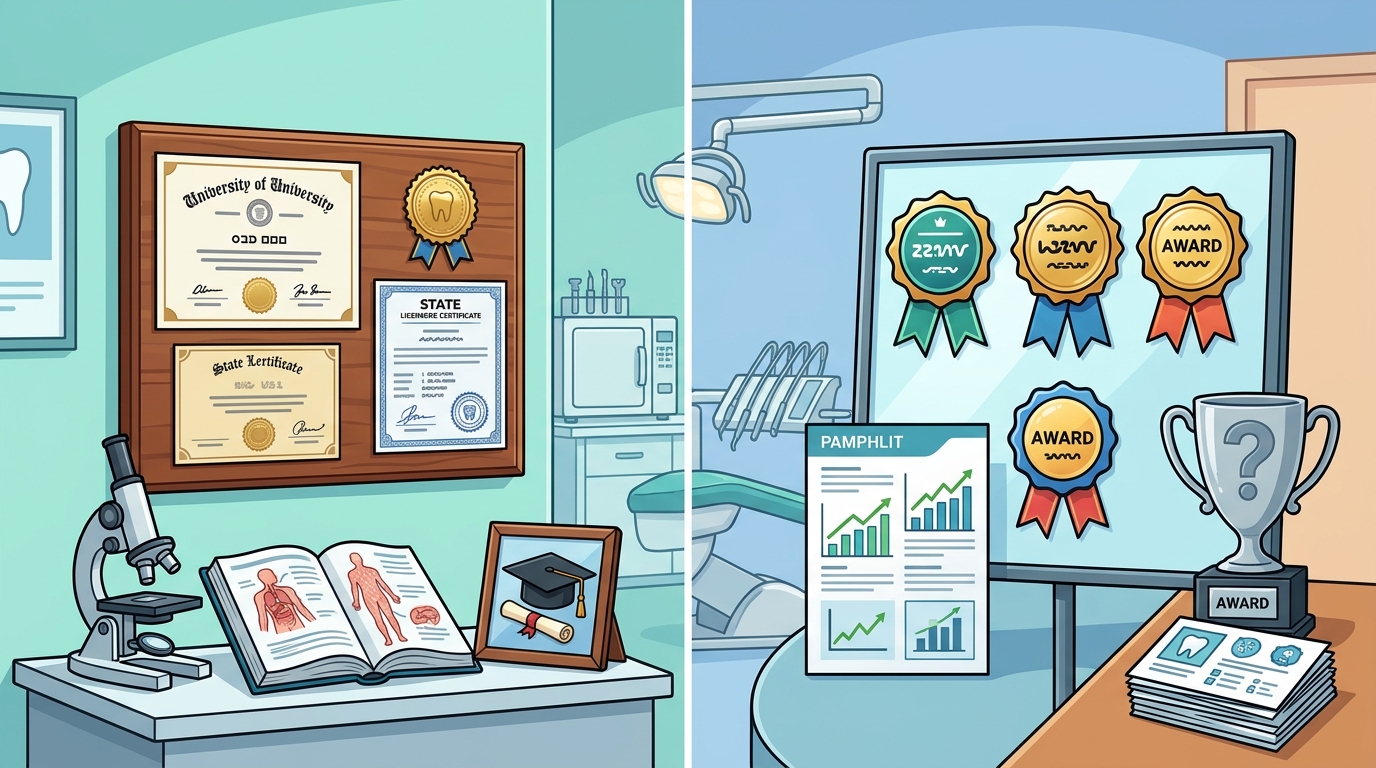
Unverified claims are statements made by dental practices or individual dentists that cannot be independently confirmed through official registries or accredited bodies. These claims often rely on subjective language, vague titles, or unproven accolades. While some marketing language is harmless, others can be misleading and obscure the true qualifications of the provider. It is essential to approach these claims with a critical eye and seek verifiable evidence.
Vague Titles and Self-Applied Labels
Some dentists use titles like "Cosmetic Expert" or "Implant Specialist" without holding the corresponding board certification or specialized training. These self-applied labels are not regulated and do not guarantee advanced competency. A dentist may perform cosmetic procedures as part of general practice without being a certified cosmetic specialist. Similarly, the term "specialist" is often used loosely in marketing, even when the dentist has not completed a residency program in that specialty. Always ask for proof of specialized training if a specific expertise is being highlighted.
Unproven Awards and Experience Metrics
Awards and experience metrics are common in dental marketing, but they are often unverified. Awards may come from private organizations with no standardized criteria, or they may be self-nominated. Experience metrics, such as "over 10,000 implants placed," are difficult to verify without access to patient records. While experience is valuable, it should be contextualized with verifiable credentials. If a practice highlights specific numbers or awards, ask for the source and criteria behind them. This helps you assess whether the claim is meaningful or merely promotional.
Comparison of Verified Credentials vs Unverified Claims
The table below summarizes the key differences between verified credentials and unverified claims. This comparison helps you identify which information to trust when evaluating a dental provider.
| Criteria | Verified Credentials | Unverified Claims |
|---|---|---|
| Source of Verification | State dental boards, accredited dental schools, recognized certification boards | Practice marketing materials, self-reported data, private award organizations |
| Independence | Independently confirmed by third-party regulatory bodies | Self-reported or controlled by the practice |
| Standardization | Follows standardized educational and examination requirements | Varies widely; no standardized criteria |
| Legal Significance | Required for legal practice; establishes minimum competency | No legal significance; purely promotional |
| Examples | State license, DDS/DMD degree, board certification | "Cosmetic Expert," "Top 10 Dentist," unverified award titles |
How to Verify a Dentist's Credentials
Verifying a dentist's credentials is a straightforward process that requires a few simple steps. By following these steps, you can ensure that the provider you choose has the qualifications they claim. This process helps you make an informed decision and feel confident in your choice of dental care.
Check State License Status
Start by checking the dentist's license status on your state's dental board website. Most state boards provide an online search tool where you can enter the dentist's name to view their license status, expiration date, and any disciplinary actions. This is the most critical step, as it confirms the dentist's legal right to practice. If the license is expired or has restrictions, it is a significant red flag.
Verify Dental School Accreditation
Next, verify that the dentist graduated from an accredited dental school. The Commission on Dental Accreditation (CODA) maintains a list of accredited dental programs. You can search for the dental school on the CODA website to confirm its accreditation status. This ensures that the dentist received a quality education that meets national standards. Accreditation is a key indicator of the rigor of the dental training program.
Confirm Board Certification
If the dentist claims to be board-certified in a specialty, verify this through the relevant certification board. For example, the American Board of Orthodontics maintains a directory of certified orthodontists. Check the dentist's name in the directory to confirm their certification status and expiration date. Board certification is a voluntary process, so not many specialists are certified, but if it is claimed, it should be verifiable. This step helps you distinguish between general dentists and true specialists.
Choosing the Right Provider Based on Credentials
When choosing a dental provider, focus on verified credentials rather than unverified marketing claims. This approach ensures that you are selecting a provider with proven qualifications and a commitment to professional standards. Here is how to apply this guidance to your specific needs.
Choose a General Dentist if
You need routine preventive care, such as cleanings and exams, or basic restorative treatments like fillings and crowns. A general dentist with a valid state license and an accredited dental degree is sufficient for these needs. You do not need a specialist for routine care. At Perfect Dental, our general dentists provide comprehensive care for the whole family, ensuring that your routine needs are met with verified expertise.
Choose a Specialist if
You have a complex dental issue that requires advanced training, such as orthodontic alignment, oral surgery, or endodontic treatment. In these cases, look for a specialist with verified board certification in the relevant field. This ensures that the provider has completed additional training and passed rigorous examinations. For example, if you are considering Invisalign, look for a provider with verified Invisalign certification. This level of specialization provides an extra layer of assurance for complex cases.
Frequently Asked Questions
Is a DDS degree the same as a DMD degree?
Yes, a DDS (Doctor of Dental Surgery) and a DMD (Doctor of Dental Medicine) degree are equivalent. Both degrees are awarded by accredited dental schools and require the same level of education and training. The difference is only in the name of the degree, which varies by institution. Both degrees qualify a dentist to practice general dentistry.
Do I need a board-certified specialist for routine care?
No, you do not need a board-certified specialist for routine care. A general dentist with a valid state license is qualified to provide preventive and basic restorative care. Specialists are recommended for complex cases that require advanced training, such as orthodontics or oral surgery. For routine cleanings and exams, a general dentist is the appropriate choice.
How can I verify if a dentist is a true specialist?
To verify if a dentist is a true specialist, check if they have completed a residency program in that specialty and hold board certification from a recognized board. You can verify board certification through the relevant certification board's website. Not all dentists who perform specialized procedures are certified specialists. Always ask for proof of specialized training and certification.
Are dental awards a reliable indicator of quality?
Dental awards are not always a reliable indicator of quality, as many awards are self-nominated or come from private organizations with no standardized criteria. While some awards may be meaningful, they should not be the primary factor in choosing a dentist. Focus on verified credentials, such as state licensure and board certification, which provide a more objective measure of professional competency.
What should I do if a dentist's license is expired?
If a dentist's license is expired, do not schedule an appointment with them. An expired license means the dentist is not legally allowed to practice. You should choose a different provider with a valid license. You can verify license status through your state's dental board website. This is a critical safety check that should not be overlooked.
Does insurance acceptance guarantee quality care?
No, insurance acceptance does not guarantee quality care. Insurance plans have their own criteria for participating providers, which may not align with professional competency standards. A dentist may be in-network with an insurance plan but still lack advanced training or board certification. Always verify a dentist's credentials independently of their insurance participation.
Final Thoughts on Verifying Dental Credentials
Verifying a dentist's credentials is an essential step in choosing a provider who can deliver safe and effective care. By focusing on verified credentials such as state licensure, dental degrees, and board certification, you can distinguish between true expertise and unverified marketing claims. This approach helps you make informed decisions and feel confident in your choice of dental care. At Perfect Dental, we are committed to transparency and providing our patients with clear information about our providers' qualifications. We encourage you to take the time to verify the credentials of any dental provider you consider. Your oral health is important, and choosing a qualified provider is the first step toward maintaining it. according to Occupational safety and
To learn more about our providers and their verified credentials, visit our Meet the Doctors page. You can also explore our locations to find a convenient office near you. For more information on our services, visit our services page. We are here to help you make informed decisions about your dental care.